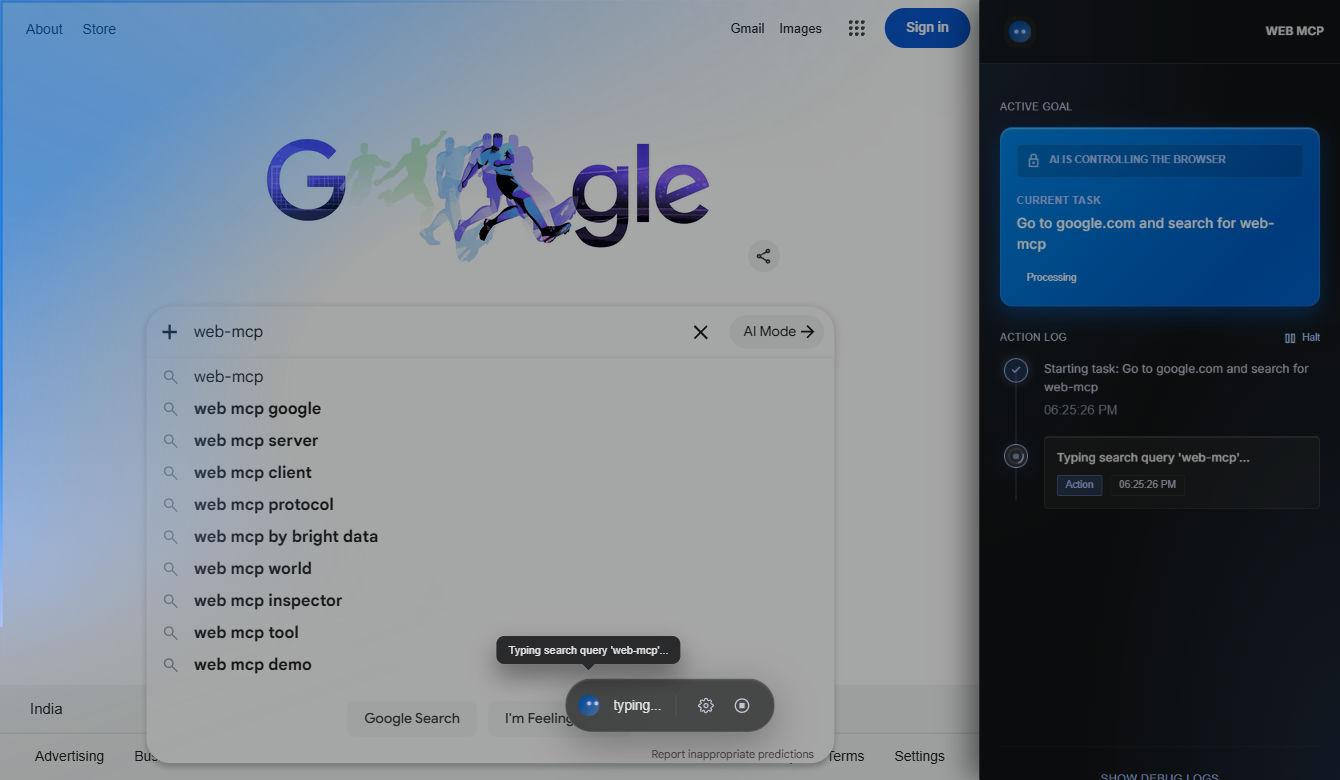
Web MCP Browser Automation for AI
AI agents needed real browsers, Web MCP was the cherry on top.
Giving AI Coding Agents a Real Browser Without Context Window Bloat
AI coding assistants such as Claude Code, Cursor, OpenCode, and Windsurf excel at generating code but operate in a vacuum,they cannot directly verify their web changes in a live browser, fill forms, or inspect runtime DOM states. Existing browser automation tools either relied on heavy remote cloud services or returned enormous raw HTML dumps that instantly exhausted the agent's context window.
Web MCP was created as a lightweight, open-source Model Context Protocol server that runs entirely on the developer's local machine. It connects AI assistants directly to a real Chromium browser via standard stdio JSON-RPC transport.
The critical engineering breakthrough was building an intelligent DOM distillation algorithm that strips away useless tags, styles, and scripts, distilling the page into an accessibility tree with interactive element IDs that the AI can click, type into, and navigate effortlessly.
Raw HTML pages distilled into compact, actionable accessibility trees.
Sub-second turnaround from agent tool call to physical Chromium interaction.
Native support for Claude Code, Cursor, OpenCode, Windsurf, and Zed.
Zero cloud proxies; all cookies, sessions, and credentials remain on machine.
High-Availability System Architecture
An open source MCP server that gives your AI a real browser. It can open pages, click buttons, fill forms and read the results while you watch. Install it with npm, run one setup command, and it configures OpenCode, Cursor, Claude Code and other MCP clients for you.
The Architecture
High-speed browser control with sandboxed safety.modern approach of delivering speed and scale.
Built strictly on the Anthropic Model Context Protocol specification with Puppeteer driving native Chromium instances on your machine.
Accessibility Tree & Action Matrix
Instead of passing megabytes of noisy HTML, Web MCP converts pages into a structured tree of clickable and fillable elements, each assigned a short numeric reference ID.
Multi-Tab Concurrent Agent Sessions
Multiple agent tasks or browser tests run concurrently across isolated browser tabs, enabling parallel research and form submission without cross-session pollution.
Zero-Config CLI Setup Command
A single setup command inspects existing developer tools on the system and automatically writes the appropriate configuration for Claude Desktop, Cursor, and OpenCode.
Live Interactive Visual Supervision
Developers can watch the browser window execute AI commands in real-time, intervening manually whenever CAPTCHAs or sensitive authentication steps arise.
Distilled accessibility trees drastically outperform raw HTML when prompting LLMs for UI navigation.
Keeping MCP servers local over stdio completely solves the credential-leakage concerns associated with remote browser farms.
Developers value watching the browser window animate live,it provides trust and immediate debugging feedback.